Showing posts with label Mid-Willamette Valley walks. Show all posts

Saturday, May 2, 2015

Monmouth


Monmouth is a lesser known Willamette Valley small city. It is not located on I-5, or on any main road to the Oregon Coast or to the Cascades. But it is a nice place to walk around, and it looks like a nice place to call home as well. Most notably, Monmouth is home to Western Oregon University, formerly the state's teacher's college, with 6,000 students. This walk goes through the university campus, along the well-preserved main street, and through some older historic neighborhoods. The walk is 2.6 miles long, and is flat.


The walk starts at the intersection of Highway 99W and the Monmouth-Independence Highway, the auto-oriented center of town, at a Burgerville. This Oregon fast-food chain (although headquartered in Vancouver, Washington) is a significant cut above the national competition, and you will pay a premium over the competition's prices to enjoy its food. It would be interesting to see future competition between Burgerville and In-n-out Burgers, should the latter chain ever make its way form a certain state to the south into the northern regions of Oregon.

From Burgerville head east on the Independence-Monmouth Highway (Independence, subject of another walk on this blog, bounds Monmouth on the east), first crossing the street to the left side. On the left are several early 20th century historic residences.


Continue on Independence-Monmouth Highway to Heffey Street, then turn left. On the corner is this old house that is in need of some at least cosmetic repair. A sign that there are still opportunities to make major contributions to the older sections of Monmouth by rehabbing old houses.


At Jackson Street turn left. The next several blocks have more historic homes, including this example of a Queen Anne vernacular style on the left.


Continue to Highway 99W. To the left is another Oregon icon (although it actually has outlets in six states), Dutch Brothers coffee. This privately-owned chain was started in 1992 by two brothers in Grants Pass, Oregon, and now has over 200 outlets. Carefully cross Highway 99W and continue west.


Once across Highway 99W continue on Jackson Street. At the corner of Jackson and Ecols, on the left, is the Ackerman House. Constructed in 1911, this bungalow-style residence was the home of John Ackerman, president of Oregon Norman School (now Western Oregon University) from 1911 to 1920.


Continue two more blocks on Jackson Street. At the corner of Jackson and Knox, to the right, is the Howell House. Built in 1891, this Eastlake Stick Style Home served for many years as a boarding house for Western Oregon University students. It is listed on the National Register of Historic Places.


Turn right onto Knox St. After one block you will see this large house on the right, and behind it is the edge of the Western Oregon University campus. The building visible in the background is Rice Auditorium, the main performing arts center on campus.


Continue north on Knox Street until it tees into Winegar Avenue. At the intersection you will see a sign that is normal around American college campuses - a "residential parking zone" sign. Students and their cars are universally unwelcome on nearby residential streets, and Monmouth is apparently no exception.


Turn left onto Winegar Avenue and follow the street as it curves. The name changes back to Knox Street after the curve. The street is lined by another common aspect of neighborhoods around American college campuses - well-used apartment buildings housing students. What differentiates this street is its median. The center street area is landscaped as a "xeriscape," which is defined as landscaping requiring little or no irrigation. A xeriscape in Oregon is going to look quite different from (and much more lush than) a xeriscape in Arizona or Nevada, but it is commendable for the city to authorize a project that doesn't need irrigation in the center median of this street.

At Gentle Street turn left. To the right is a parking lot and beyond the lot is the Gentle House. The house was constructed in 1880. Both the structure and its grounds were donated by the Gentle family to Western Oregon University, which makes the house available for public functions.


Gentle Avenue tees into Monmouth Avenue. Turn left onto Monmouth and enter the Western Oregon University campus. The school was founded in 1856 as a private Christian college. It became Oregon Normal School, a state college, in 1882. After a brief closure for lack of funds in 1909 it reopened in 1911. In 1939 it became Oregon Teacher's College. In 1981, to reflect the growing curriculum it became Western Oregon State College, and was upgraded to University status in 1997. The 156-acre campus now serves approximately 6,000 students.

Continue along Monmouth Street. Painted onto the sidewalks are these large paw prints. The university's sports teams are the Western Oregon Wolves.


On the right is the Werner University Center, the hub of campus activity. Originally built in 1960, it has seen significant remodeling and expansion over the years to serve the growing student population.


After crossing Church Street, on the right is Todd Hall, originally constructed in 1912. It was the first dormitory on campus, exclusively for women. Now it serves as the location of the school's Teaching Research Institute. It reportedly hosts the ghost of it's namesake, Jessica Todd.

Next on the right is Campbell Hall, which was originally built in 1871 but extensively remodeled since. One of the remodelings was necessary after the 1962 Columbus Day Windstorm blew off its bell tower. In front of Campbell Hall is a 125-foot tall Sequoia tree, planted in 1887.

On the left, across from Campbell Hall, is the university's Instructional Technology Center. (In case you haven't figured it out, Western Oregon University still heavily emphasizes education and training of elementary and secondary school teachers). The building was originally constructed in 1915.

At the edge of the campus, at the corner of Jackson and Monmouth Streets to the left, is the former Community Evangelical Church. Originally constructed in 1891, it was moved to this site in 1922 on wooden rollers. The steeple was another victim of the 1962 Columbus Day Windstorm. The building is now occupied by the non-denominational Heart to Heart Church, which doesn't have a website but does have a Facebook Page.


Across from the church is West House. This attractive colonial structure was built in 1924. It became the school's male dormitory in 1937 (as is fitting for a mid-20th century teacher's college, the men's dorm was smaller than the women's dorm!). It now houses two of the university's academic departments.

Turn right onto Jackson Street. After one block you will see McArthur Stadium to the right, home to the Western Oregon Wolves football team. The university is part of the Great Northwest Athletic Conference in NCAA Division II, and is not in the same conference as nearby Willamette or Linfield Colleges. The stadium was built in 1980, replacing wooden Memorial Stadium. The previous stadium burned to the ground in 1979, according to some sources in "spectacular fashion."
After two blocks on Jackson turn left onto Whitman and then left again onto Main Street. After 1 1/2 blocks St. Hilda's Episcopal Church, housed in this quaint structure, will be seen on the right. The building was constructed in 1935.


Continue west on Main Street, which is indeed Monmouth's traditional "main street," On the right is the Monmouth City Hall. The city's staff is apparently packed into this nondescript building, and the city is considering options for expansion. Monmouth is notable for incorporation in 1856 as a "dry" city, and the city remained liquor free (or at least liquor store free) until voters finally changed the city charter in 2002.

After crossing Warren Street you will see Main Street Park on your left, a traditional looking central park square with a pretty gazebo. In front of the park is this giant flagpole, proudly flying the American, Oregon, and Monmouth city flags.


On the right side of the street, across from Main Street Park, is the M.I. (Monmouth Improvement Company) building. The structure, built in an Italianate style, has been on this site since 1902.


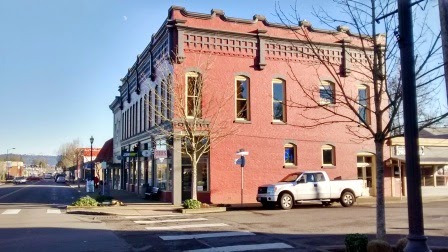
Continue along Main Street, which has several early 20th century commercial structures. Most notable is this building at the corner of Main and Broad Streets. It is known as the Polk County Bank Building. It was constructed in 1889 and has been listed on the National Register of Historic Places.

Continue another three blocks along Main Street to the starting point of the walk, Burgerville.

Monday, February 2, 2015

Salem - Deepwood Estate and Bush's Pasture Park

Oregon's State Capitol city, often derided as a dull place, is actually, once you scratch the surface, a city with lots of interesting sights and activities. This walk will take you south of the State Capitol, through the Willamette University Campus, to the Historic Deepwood Estate and Bush's Pasture Park before returning through Salem's public hospital and the University campus to the Capitol building. There's lots of interesting architecture to look at along the route. The walk is 2.6 miles long, and has one significant hill n the neighborhood south of Bush's Pasture Park.


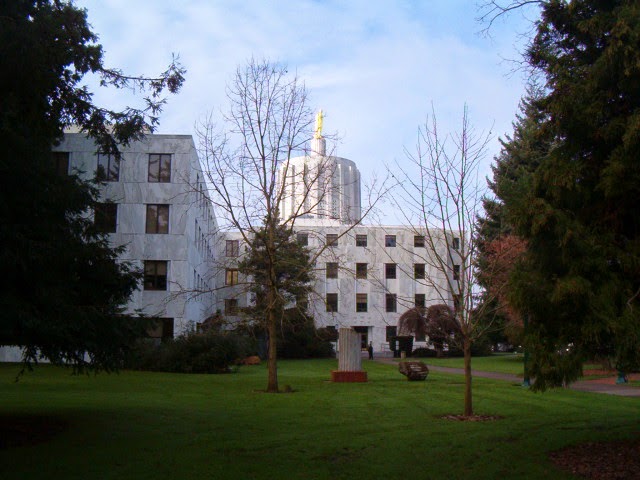
This walk starts at the beautiful Oregon State Capitol, constructed in 1938 after the previous capitol building burned to the ground in 1935. The part of the building in the foreground in this photo is actually one of two major 1977 additions, one on either side of the original building. This side is occupied by State Senators and their staffs. The entire building is scheduled to be vacated for over a year after the 2015 legislative session to accommodate a major seismic upgrade.

Start at the State Street side of the Capitol and turn left. Cross at the crosswalk near the intersection of State and Waverly to the Willamette University campus on the south side of State Street. The first building you will see is the newest major building on campus, Ford Hall. Named for major contributor Hallie Ford (she also has the university art museum named for her), the building was completed in 2009 and houses several university liberal arts programs.

Walk to the right of the Ford Center, and then continue to the right of the next building, Smullin Hall, which houses Willamette's information technology functions. Once past Smullin Hall turn left, and to your right will be the Pelton Theater, guarded by two lions out front. The theater was completed in 1923.


Once past the Pelton Theater and the parking lot next to it, turn right. Continue to a bridge over Mill Race Stream. Immediately beyond is the Martha Springer Botanical Garden, opened in 1998 as a tribute to a long-time biology professor. The small one-acre garden includes 12 micro-gardens. Mill Race is a diversion from Mill Creek to Mission Creek that provided water power to the Thomas Kay Woolen Mill located upstream from this location as well as several other long-ago departed industrial enterprises.

After crossing Mill Race and looking at the botanical garden veer right and and then go straight ahead. On your right is the Mark Hatfield Library and on the left is the Sparks Athletic Center. Once you get to the parking area turn left along the sidewalk and pass by the front of the Sparks Center. Continue to the right along the side of a soccer field until you get to Bellevue Street.

Turn left onto Bellevue, and after one block use the crosswalk to turn right on 12th Street. As you proceed south you will see, in the distance to the left, Salem's Amtrak Station, a beautiful Beaux-Arts style building constructed in 1918. Continue along this busy, undistinguished section of 12th Street, to Mission Street. You will pass by the popular Ram pub as well as a bridge over "Mission Creek" (about which more will be said later on the walk).

After you cross Mission Street the scenery takes a turn for the better. To the right is the Historic Deepwood Estate. This four-acre site is owned by the City of Salem as a public park, but the 1894 Queen Anne-style mansion is managed by Friends of Deepwood Estate, who provide organized tours of the home. The estate was given its name by Alice Powell, its final owner before the City acquired the property in 1971.


The estate is much more than just the grand mansion - the four acres of grounds also include beautiful gardens and a greenhouse that are open for free to the public. It is worth your time to wander through the gardens to admire the flora.


After you walk around and enjoy the Deepwood Estate grounds, go back onto 12th Street. After passing Lee Street, turn right onto Waller Street. After a block of ordinary apartment buildings you will come to this bridge, which crosses Pringle Creek. Use the bridge to cross the creek, then turn left onto the pathway.

You are now entering Bush's Pasture Park, a 90-acre greenspace. A stroll through the western half of the park is included on this walk - our route will go through the eastern part of the park. Continue past the trees into a large open grassy area, with trails that see a lot of use by joggers. Continue to the edge of the park at Leffelle Street, then turn right onto Leffelle (or stay on the pathway at the edge of the park which parallels Leffelle).
The neighborhood south of Bush's Pasture Park contains a number of old, attractive houses, such as this bungalow-style home, built in 1920, at the corner of Leffelle and Davidson.


Continue on Leffelle to its end at Summer Street, then turn left. Go one block and then turn right onto Cross Street. Go up a short hill on the next block, and at the top of the hill, after crossing Winter Street, is this stately Georgian-style home, built in 1934 for Custer Ross, a prominent local attorney. The American elm tree in front of the house is a lot older, dating from 1890, and is a Salem Heritage Tree

At Cottage Street turn right, and after one block you will reenter Bush's Pasture Park. Continue on the park trail that veers slightly to the left, on level terrain. When this path T's into another walking path turn right, and start going down a hill.


As you start on this path down the hill, to the right you will see this statue. It is entitled "Guidance of Youth," and depicts a pioneer family resolutely striding forward, presumably toward Oregon on the Oregon Trail. It was commissioned and placed on this spot in 1959 to commemorate the centennial of Oregon's admission as a state to the Union. Not mentioned on the plaque to the back of the statue is its interesting back story. It was commissioned and paid for with a $34,000 bequest from Carroll Moores, an evidently very thrifty janitor for the Oregon Supreme Court building. An earlier idea to use the money to purchase a painting of a nude by Auguste Renoir was the subject of significant local controversy, and was rejected.


After viewing the statue return to the trail and continue down the hill. You will be leaving the forested portion of the park and heading back into the grassy field portion of Bush's Pasture Park, but the last of the trees is this beautiful deciduous specimen.

At the bottom of the hill continue on the trail to the left. You will skirt the perimeter of the Willamette University baseball field and the University's McCulloch football stadium. The Willamette Bearcats participate in the NCAA at the Division III level. While the Bearcats don't have the consistent level of football excellence found at rival Northwest Conference foe Linfield College in McMinnville, the school plays at a generally high level, last winning the conference championship in 2008.

As you pass by the football stadium the trail branches. At the first branch go to the left, and almost immediately the trail will branch again - at this point, go to the right. You will be heading for the intersection of Mission Street and Winter Street. Cross Mission at the signal light, and proceed up Winter Street. You will soon be in going through the massive Salem Hospital campus. Salem Hospital is the only major public hospital in the city. Its recent plans to expand westward to Church Street has engendered some local controversy.

At the north end of the Salem Hospital campus, between the hospital and Bellevue Street, you will pass over this waterway (earlier you passed over it while on 12th Street near the Ram Restaurant). It is shown on some maps as Mission Creek, but it is actually the Shelton Ditch, a diversion canal from Mill Creek to Pringle Creek originally constructed in the mid-19th century. It is part of the complex set of creeks and ditches serving Salem with water that is for the most part diverted from the Santiam River to the south.

After Sheldon Ditch, you will cross busy Bellevue Street and continue north on Winter Street. You are now back at the edge of the Willamette University campus. On the left side of Winter, across from the main campus, is the Willamette University College of Law. The college is one of three law schools in Oregon, and has a healthy rivalry with the University of Oregon and Lewis and Clark law schools. The law school's main building, the Truman Wesley Collins Legal Center, was built in 1967,


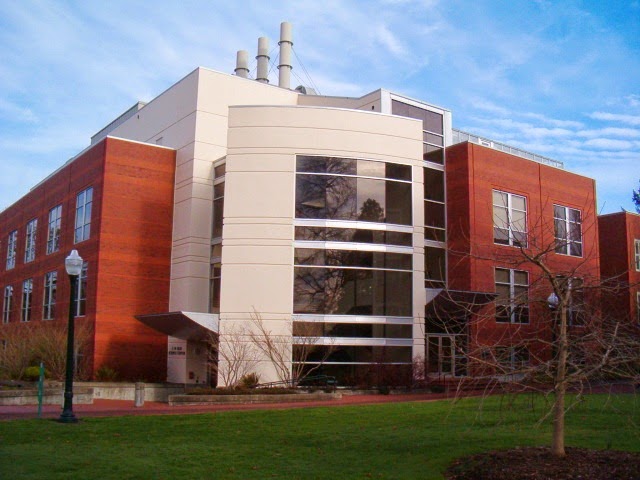
To the right on Winter Street, before its intersection with State Street, is the Olin Science Center, constructed in 1995 and housing Willamette's biology and chemistry departments. 


Continue on Winter Street until it tees into State Street. On the block to the left are a series of interesting buildings. On the corner is the Civic Justice Center, home of the Oregon Law Commission, which inhabits Salem's 1912 Carnegie Library, with a classic beaux arts style used in many such libraries around the world. It served as Salem's public library until 1971, then was used by the YWCA until 2008, when it was refurbished by the law school and dedicated by none other than Supreme Court Justice Ruth Bader Ginsburg. Next on the block is the modern-style YWCA building, which has now been vacated by the YWCA, constructed in 1954. The architect was Pietro Belluschi. Next down is the art-deco style Pacific Telephone and Telegraph building, now occupied by CenturyLink, built in 1930. Finally, on the corner of State and Cottage, is the Hallie Ford Museum of Art, opened by Willamette University in 1998, with an excellent collection.

After taking a look at these buildings, turn right on State Street and return to the State Capitol. You will pass by the other 1977 addition to the original capitol, which primarily is occupied by members of the State House of Representatives and their staffs.

About Me

Blogs about biking and walking in the Pacific Northwest